A Nobel laureate and Oregon's quantum push
When David Wineland joined the University of Oregon’s physics faculty in 2018, he brought decades of groundbreaking research with him—and added momentum for Oregon’s growing strength in quantum science. His arrival also illustrated how philanthropy can help attract world-class researchers to Oregon, creating opportunities for students and faculty to work alongside leaders in their fields.
As Philip H. Knight Distinguished Research Chair, Wineland demonstrates the power of endowed faculty positions to strengthen areas of excellence and build a community where leading researchers, emerging scholars, and students can work together to explore some of the world’s biggest questions.
From Nobel-winning research to new possibilities
Wineland shared the 2012 Nobel Prize in physics with Serge Haroche of Collège de France and École Normale Supérieure in Paris, France, for their groundbreaking experimental methods that made it possible to measure and control individual quantum systems without destroying their delicate quantum properties.
Their complementary approaches opened new possibilities for quantum research. Wineland and his colleagues developed ways to trap electrically charged atoms, called atomic ions, and control their quantum properties using electromagnetic fields, including light. Haroche and his colleagues developed methods to control the quantum properties of electromagnetic fields through their interactions with neutral atoms.
The work helped scientists explore how those atoms, neutral and charged, could function as quantum bits, or “qubits”—the basic units of information in quantum computing. This fast-moving field could one day allow researchers to tackle certain problems that are beyond the reach of today’s classical computers.
Wineland built his scientific reputation through a decades-long career at the National Institute of Standards and Technology in Boulder, Colorado, where his group’s research contributed to extraordinarily precise atomic clocks and helped lay groundwork for quantum computing.
He chose Oregon for its innovative physics department and the chance to push quantum science further with his UO colleagues.
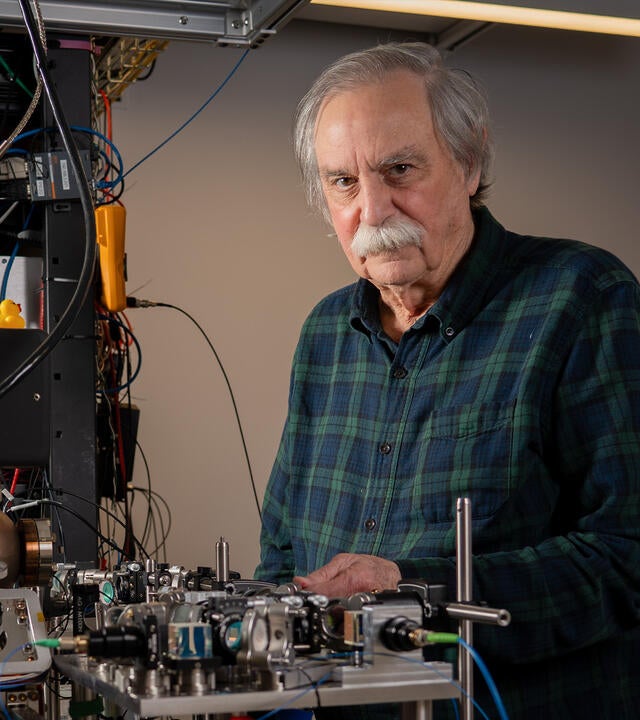
What attracted me to Oregon was the opportunity to work with talented colleagues and students who bring new ideas and perspectives to the field. Having that kind of collaborative environment is essential to advancing research and preparing the next generation of scientists.”
David Wineland
Philip H. Knight Distinguished Research Chair
Building the next generation of quantum discovery
Wineland and fellow physicist and courtesy associate professor David Allcock (who founded Oregon Ions and is now at the quantum computer company IonQ) were able to bring in research assistant professor Jameson O’Reilly, who now also serves as a principal investigator in the Oregon project.
In this “trapped-ion” lab, researchers use electromagnetic fields to hold electrically charged atoms in place, studying how they might be controlled with the extraordinary precision needed for quantum technologies.
For students and early-career researchers, the lab offers an opportunity to learn alongside scientists whose work has helped shape the field—and to contribute to knowledge and technology that could shape its future.
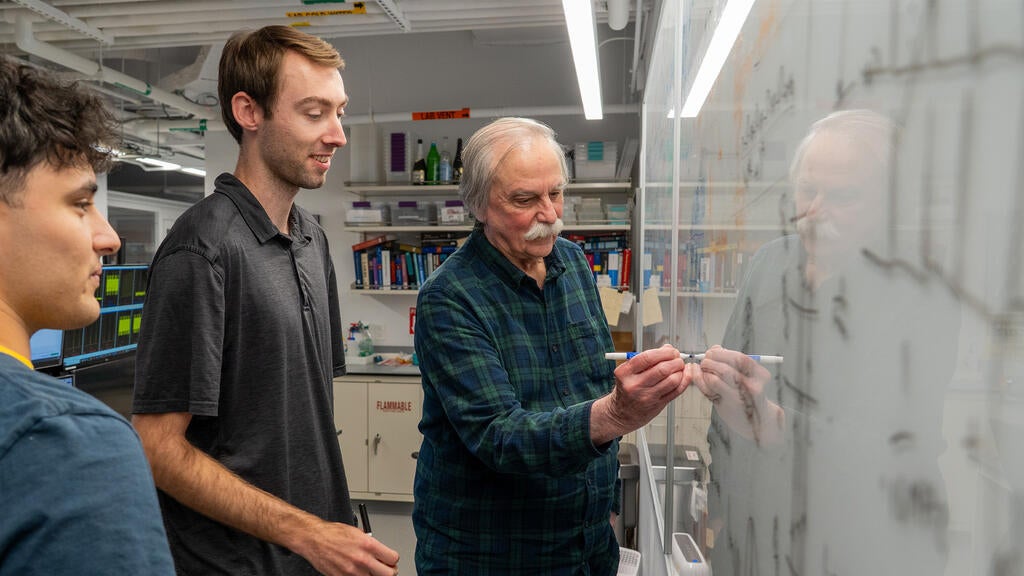
Wineland sees that potential firsthand in the students he mentors.
“One of the most rewarding parts of this work is seeing students develop the confidence to ask their own questions and find creative ways to answer them,” Wineland said. “They're entering the field at a very exciting time, and I hope their experiences here prepare them to make discoveries we can’t yet imagine.”
That combination of established expertise and emerging talent is helping Oregon drive progress in a rapidly developing field. Oregon Ions researchers are involved with major federally funded collaborations advancing quantum science.
Oregon Ions is part of Q-SEnSE, a National Science Foundation Quantum Leap Challenge Institute supported by a $37.5 million, five-year grant. The national collaboration brings researchers together to advance quantum sensing, develop new technologies, and train a workforce prepared for the growing quantum field.
Vision, velocity, and novel possibilities
Wineland’s work is part of a much larger community of quantum research at Oregon. He is affiliated with the Oregon Center for Optical, Molecular, and Quantum Science, home to more than a dozen research teams. The center unites faculty members in physical chemistry and physics to study how light and matter interact—and how those interactions might lead to new technologies.
The possibilities stretch from more precise sensors and telescopes to new ways of processing information and sharing information securely.
As Oregon builds on its strengths in quantum science, philanthropic support can help researchers explore promising new directions, including early-stage ideas that may eventually attract substantial federal investment.
“Philanthropic support enables us to pursue new, riskier research directions that have a better chance to break truly new ground,” O’Reilly said. “Getting preliminary data goes a long way towards establishing a sustainable, federally funded research program.”
The potential for discovery extends beyond any one scientist or lab. By investing in exceptional faculty and the students and researchers who learn alongside them, Oregon can continue building the people and ideas that will help shape what comes next—in quantum science and beyond.