Everyone remembers that one professor
Twenty years ago, Brendan Bohannan, the James F. and Shirley J. Rippey Chair in Liberal Arts and Sciences, gave up a coveted tenured position at Stanford University to join the University of Oregon.
What drew him was what he describes as public universities’ responsibility to serve their students and their state in ways that private institutions do not. He sees his role at the UO as an opportunity to connect with all Oregonians, including, as he said, “people who might not think that university education is an important thing.”
That commitment is personal for Bohannan. His father never finished high school, his mother never started, and his grandparents had only a primary school education. As the first in his family to attend college, he brings an understanding of the barriers to higher education to his teaching—and its potential to open new opportunities.
“When I meet students who struggled to get here and are still confused about what a university is all about, I’m the happiest when I can help them a little bit,” he said.
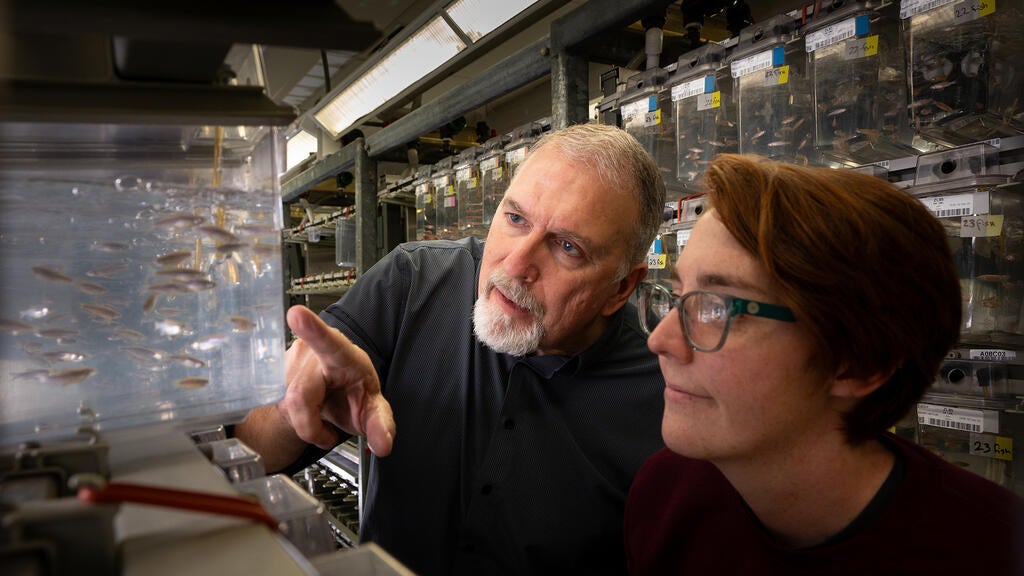
Today, Bohannan connects with students like these in his biology courses and through his lab, the Bohannan Research Group, which studies microbial biodiversity—the vast array of bacteria and other microscopic life that live in and around us. By working with students to better understand this field, he is helping advance modern medicine. Ongoing donor support through his endowed professorship helps make Bohannan’s work possible.
It's obvious these students had to sacrifice a lot, and their families have had to sacrifice a lot for them to be here. So, I try to make it worth their while.”
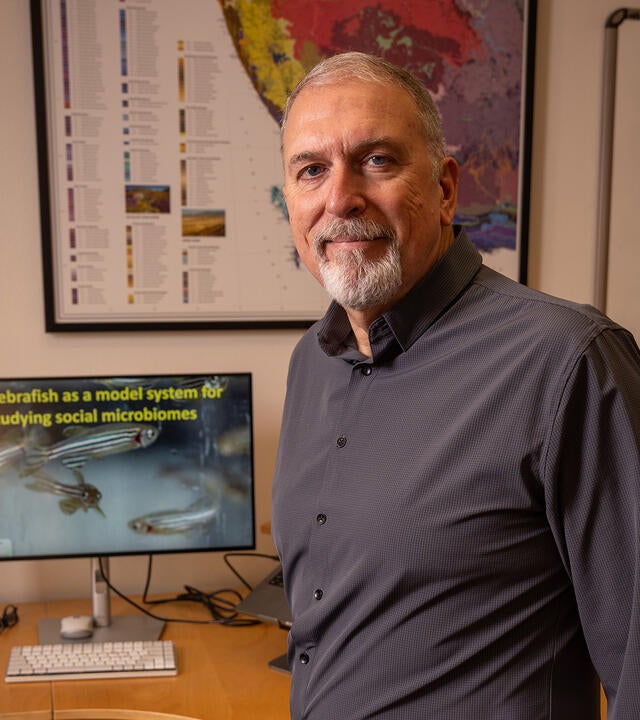
Professor Brendan Bohannan
James F. and Shirley J. Rippey Chair in Liberal Arts and Sciences
Grit, sacrifice, and pathfinding
Bohannan finds deep inspiration in undergraduates who have shown tremendous grit—and whose families have made big sacrifices—to attend the UO.
“To be at the university and to be dreaming of a career like medicine or biomedical research—those students, I just find really inspiring,” he said.
The effort shows. In a recent term, 88 percent of the seventy-six students in Bohannan's flagship course, “Accelerated Biology III,” planned to pursue a career in clinical medicine. In response, he added new career exploration opportunities where students can talk with local medical professionals. He’s also creating a new course for premed students tentatively titled, “Applications of Ecology and Evolution in Human Medicine.”
Another teaching highlight for Bohannan: those moments when undergraduates discover their passions.
One sophomore in his biology class, which features three hours of lab work each week, was initially intent on a premed track.
But in the lab, her path came into focus.
“She’s just fallen in love with the idea of research, with thinking about a career of asking questions and answering questions,” Bohannan said. “I’ve seen her really blossom.”
Today, that first-generation student from Portland works as an undergraduate researcher in a University of Oregon research group, getting hands-on experience with the scientific method.
Bring great professors to Oregon
Brendan Bohannan left Stanford to teach and mentor here. Help Oregon attract more minds like his to impact those around them.


Rewilding an Oregon strength
Much of Bohannan’s research investigates how humans acquire their microbiomes and uses zebrafish to explore this. The UO is famous for developing this model research species, but little is known about the fish outside the lab setting.
With the financial support of his endowed professorship, Bohannan set out to change that.
He traveled to Nepal in October 2025 to study zebrafish in the wild, partnering with scientists from Agriculture and Forestry University in Chitwan, known for its strong aquaculture program.
Bohannan theorized that “rewilding” zebrafish—or restoring the natural microbes they carry in the wild rather than in the lab—may make them a more accurate model for human health.
The project, Bohannan mentioned, is a novel combination of two of the UO's great strengths: its world-famous zebrafish research and its environmental inquiry.
“Being able to study this really powerful lab model in its natural environment—it just feels profoundly Oregon,” he said.
His trip led to a formal partnership with the Nepali university. Bohannan and two Nepali collaborators held a five-day symposium in Oregon that attracted a faculty audience three times larger than he expected.
Bohannan is also working with UO leaders to create a new student exchange program with the Nepali university, where students from each school can study at the other. Bohannan said this was inspired by his pre-med science students, whose demanding course loads leave little space to study abroad.
The staying power of Oregon
The James F. and Shirley J. Rippey Chair in Liberal Arts and Sciences gives Bohannan the ongoing freedom to infuse creativity into all areas of his teaching and research.
With that consistent support, he expands his scientific inquiry into endless avenues. Bohannan actively collaborates with colleagues in disciplines ranging from anthropology to microbiology, physics to philosophy.
“And Oregon feels unique in this regard,” he said. “I’ve been at other universities, and it’s popular to talk about collaboration, but we really do it here. It attracted me here initially, and it has certainly kept me here over the years.”