Collaborating to transform healing
Marian Hettiaratchi, an associate professor of bioengineering, was looking for the right place to launch the next phase of her career. Following her postdoctoral studies at the University of Toronto, she found something compelling at the University of Oregon.
The promise of the Phil and Penny Knight Campus for Accelerating Scientific Impact drew Hettiaratchi to the university. When she first visited the UO, the Knight Campus was just starting construction. But she could already see its potential as a place built to bring researchers across disciplines together, remove barriers to collaboration, and accelerate discoveries toward real-world impact.
“I was excited about the idea of the Knight Campus, being able to be part of something at the very start,” she said.
Today, Hettiaratchi holds the donor-supported Lary Simpson Professorship and is helping realize the potential she saw in the Knight Campus from the beginning. Her work brings fundamental science closer to real-world healthcare applications while preparing the next generation of engineers and scientists to tackle challenges of their own.
She’s also helping ensure that more students have opportunities to learn, contribute, and build careers in science, engineering, and math.
Built for collaboration
Hettiaratchi’s lab is located in the 345,000-square-foot Knight Campus, where proximity opens doors. Scientists with different specialties work alongside one another, creating opportunities for unexpected connections and new approaches to complex problems.
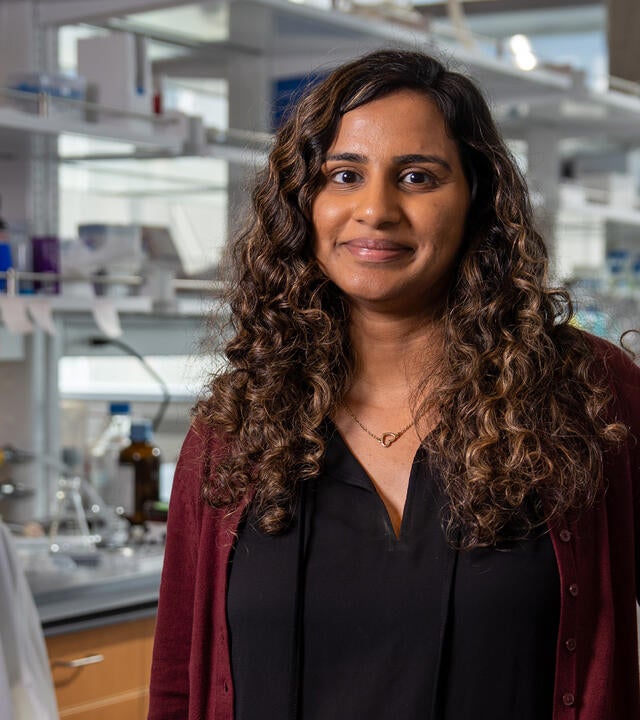
There is definitely a lot of support from the university and the department to try to do things that haven't been done before. That's made it easier to pursue riskier ideas.”
Marian Hettiaratchi
Lary Simpson Professor, Associate Professor, Department of Bioengineering
Her team studies how to deliver proteins that help the body repair tissue after traumatic injuries. That research has led to a promising innovation: an injectable, water-based material called a hydrogel that can help accelerate bone regeneration.
The possibilities now extend beyond bone repair to muscle regeneration, blood vessel growth, and neural probes designed to better integrate with the brain.
For Hettiaratchi, this breadth of discovery reflects a culture where seeking out new perspectives comes naturally.
“I feel like collaboration is easy at Oregon because people are very willing to provide resources and expertise,” she said. “There are really no barriers to someone trying to help you or you trying to help someone else.”
When students connect the dots
One collaboration began when Hettiaratchi’s students spotted a challenge that could stand between their research and its eventual use in patients.
The hydrogels they were developing were, as Hettiaratchi put it, “weaker than Jell-O.” Injected into the body on their own, the materials could wash away before they had time to do their job.
Nearby, fellow bioengineering associate professor Paul Dalton—whose position is also donor-supported through the Bradshaw and Holzapfel Research Professorship in Transformational Science and Mathematics—was working on a potential piece of the solution. The Dalton Lab had developed nanofiber mesh scaffolds designed to support tissue regeneration.
The students saw an opportunity: What if they combined the two?
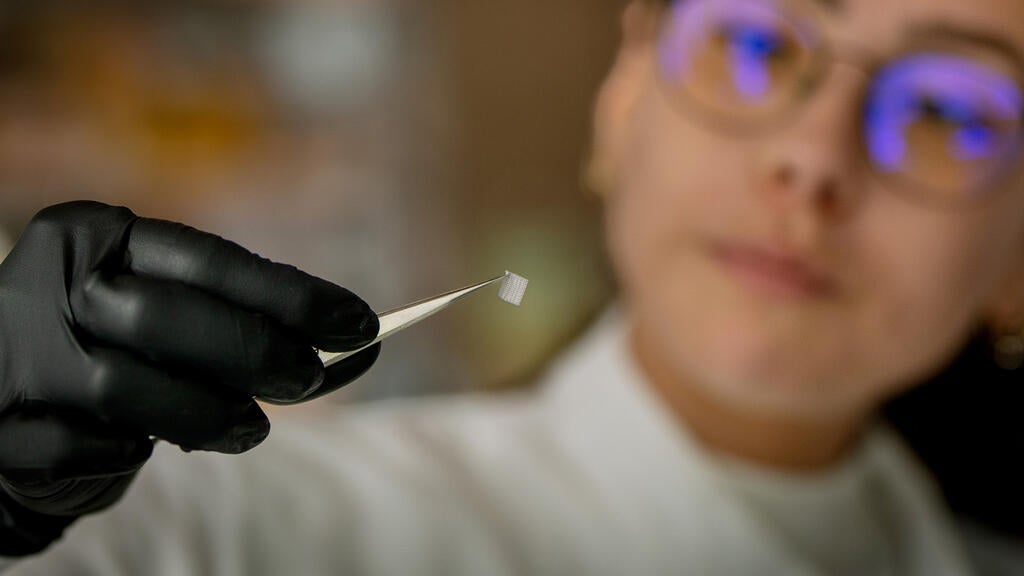
Students from both labs joined forces, placing the hydrogel inside a cylinder made from the nanofiber mesh. The approach worked, and the team is now preparing a peer-reviewed paper on the research.
“I was most excited that the students took the initiative to address problems that could stall moving our work to the clinic now, rather than having to figure it out several years down the line,” Hettiaratchi said.
Let’s expand the infrastructure for collaborative research
Support the kind of groundbreaking work that’s happening in Marian Hettiaratchi’s lab.


Freedom to take risks
Hettiaratchi's Lary Simpson Professorship shows how philanthropy can accelerate discovery at Oregon. The support gives her flexibility to nurture student-driven ideas and pursue promising research that may not fit neatly within the constraints of traditional funding.
That flexibility creates room for experimentation that can lead to breakthroughs: following an unexpected lead, bringing in a collaborator, or testing an idea before knowing exactly where it will go. It also gives students chances to contribute to emerging research and develop solutions alongside faculty mentors.
“There is definitely a lot of support from the university and the department to try to do things that haven't been done before,” Hettiaratchi said. “That's made it easier to pursue riskier ideas.”
With philanthropic investment, Oregon can create more opportunities for researchers and students to take those risks together—accelerating promising ideas, pushing discoveries closer to patients, and building the next generation of scientific innovators along the way.